Beyond the Bind: How Coil Coating Technology Defines Notebook Quality, Durability & Brand Value
- Share
- publisher
- Ethan
- Issue Time
- Oct 30,2026
Summary
Nylon/PET/R-PET coatings, 270° end-bending, adhesion, salt spray, color, compliance affect durability and brand value.
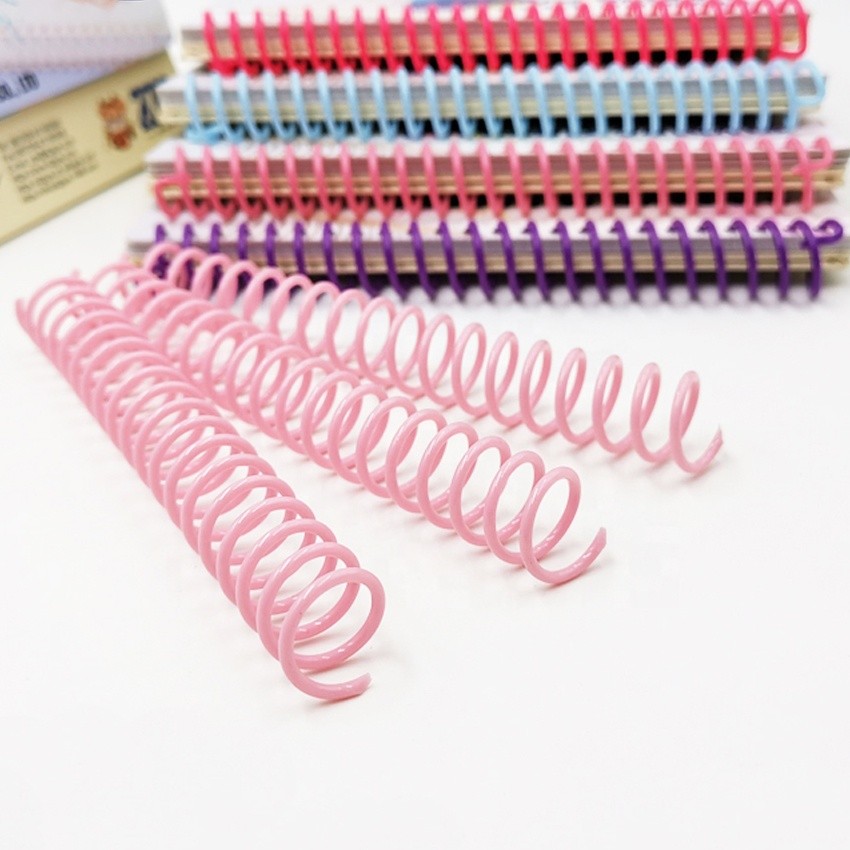
A deep dive into the surface treatment technologies behind binding coils — from nylon and PET coatings to end-bending precision — and why they matter more than you think.
The Hidden Layer That Makes or Breaks a Notebook
When buyers evaluate spiral notebooks, their attention naturally gravitates to the paper quality, the cover design, the coil type. But there is a critical element that sits at the intersection of all three — one that is almost invisible, yet determines whether a notebook lasts three months or three years: the coil's surface coating.
The coating on a binding wire is not merely a color layer. It is an engineered barrier that controls corrosion resistance, tactile feel, color vibrancy, coating adhesion, forming speed, and even environmental compliance. A poorly coated coil can rust within weeks in humid climates, scratch desk surfaces, snag fabric, leach harmful substances, or crack during the binding process itself. A well-coated coil, by contrast, delivers a premium tactile experience, decades-long durability, flawless brand-color matching, and full compliance with international safety standards.
At YPS Binding Technology, we have spent over a decade refining our coating processes across three primary systems: nylon coating, PET coating, and R-PET (recycled PET) material formulation. This article pulls back the curtain on these technologies — what they are, how they are applied, how to evaluate them, and why your coil supplier's coating capability directly impacts your product's market success.
Part 1: The Three Coating Systems Explained
1.1 Nylon Coated Binding Wire (NC Wire)
Nylon coating is the industry standard for metal binding wires — both single spiral and double loop (twin loop) varieties. The process involves drawing steel wire (typically Q195-grade) through a nylon extrusion layer that bonds to the metal surface at a molecular level.
How it works: The raw steel wire is first cleaned and surface-treated to ensure maximum adhesion. It is then passed through a nylon resin extrusion die, where a thin polymer layer (typically 0.02-0.05mm thick) is applied continuously along the wire length. The coated wire is then cooled, tested for adhesion and uniformity, and wound onto spools for subsequent forming into coils or double-loop shapes.
Technical Specifications (YPS Standard):
Parameter | Specification |
|---|---|
Base Material | Q195 carbon steel wire |
Coating Material | Nylon polymer (eco-friendly, SGS-certified) |
Wire Diameter Range | 0.60mm – 2.00mm |
Available Gauges | 0.60, 0.70, 0.75, 0.80, 0.85, 0.90, 0.95, 1.00, 1.10, 1.15, 1.20, 1.25, 1.30, 1.40, 1.50, 2.00mm |
Coating Thickness | 0.02-0.05mm |
Coating Adhesion | Passes cross-hatch test (ASTM D3359) |
Surface Finish | Smooth, glossy, low-friction |
Tensile Strength | Consistent, failure-free operation |
Key performance characteristics:
- Extreme formability: The nylon layer stretches and bends with the wire during the coil-forming process without cracking or peeling. This is critical — if the coating cracks during forming, the exposed steel will rust.
- Low friction resistance: The smooth nylon surface allows the wire to feed through automated binding machines at high speed without jamming. This directly impacts production efficiency for large-volume orders.
- Excellent adhesion: A quality nylon coating bonds to the steel at a molecular level. If you can scrape it off with a fingernail, it has failed.
- Corrosion protection: The nylon layer acts as a complete moisture barrier, preventing steel oxidation even in humid environments.
Color options:
Color Category | Available Colors |
|---|---|
Standard | Black, White |
Extended | Red, Blue, Green, Orange, Yellow |
Special / Metallic | Coffee, Silver, Gold, Bronze |
Custom | Full Pantone color matching (OEM) |
1.2 PET Coated Binding Wire
PET (polyethylene terephthalate) coating is an alternative polymer system used primarily for metal single binding wires. PET coating offers distinct advantages over nylon in certain applications, particularly where higher chemical resistance and UV stability are required.
How it differs from nylon coating: PET is a thermoplastic polyester with a more rigid molecular structure than nylon. The application process is similar — extrusion coating onto pre-treated steel wire — but the resulting surface has a slightly harder, more glass-like finish compared to nylon's slightly softer, rubber-like feel.
Key performance characteristics:
- Superior chemical resistance: PET resists a wider range of solvents, oils, and cleaning agents than nylon. This matters for notebooks used in laboratory, industrial, or food-service environments.
- UV stability: PET coatings maintain color integrity longer under ultraviolet exposure. Nylon coatings, particularly in lighter colors, may yellow slightly over years of UV exposure (though UV-stabilized nylon formulations mitigate this).
- Smooth surface processing: The PET surface is extremely smooth, enabling very high forming speeds on automated binding equipment. For high-volume production runs, this can meaningfully reduce per-unit binding time.
- Environmentally friendly: PET is a recyclable thermoplastic. The coating can be separated from the steel during recycling processes, making end-of-life recycling more straightforward.
Technical Specifications (YPS Standard):
Parameter | Specification |
|---|---|
Base Material | Q195 carbon steel wire |
Coating Material | PET polymer |
Wire Diameter Range | 0.7mm – 2.0mm |
Pitch Options | 2:1, 3:1 |
Surface Finish | Smooth, glossy |
Net Weight per Reel | 380-420kg |
Color Options | Black, White, Red, Blue, Green, Gold, Silver + Custom |
Forming Method | Plastic coil forming machine |
1.3 R-PET Plastic Coils (Recycled PET)
Moving beyond metal wire coatings, we enter the realm of fully plastic coils — spirals formed entirely from PET material, with no metal core. These are the coils of choice for children's products, outdoor notebooks, and any application where 100% rust-proof performance is non-negotiable.
R-PET represents the eco-friendly evolution of this category. R-PET (recycled polyethylene terephthalate) is manufactured from post-consumer recycled plastic — primarily recycled water and beverage bottles. The material is cleaned, pelletized, melted, and extruded into continuous filament that is then formed into spiral coils.
Why R-PET matters:
- Circular economy: Each kilogram of R-PET coil diverts approximately 45 plastic bottles from landfills. For a 10,000-unit notebook order using R-PET coils, that is roughly 500kg of recycled plastic — a measurable, marketable sustainability story.
- Certified safety: R-PET material can achieve food-grade certification, making it safe for children's products that may be mouthed or chewed. YPS provides annual test reports confirming compliance with EN71-3 and REACH standards.
- 100% rust-proof: No metal component means zero corrosion risk — ever. These coils can be submerged in water without degradation.
- Full recyclability: At end of life, R-PET coils can be recycled again, creating a true closed-loop material cycle.
Technical Specifications (YPS Standard):
Parameter | Specification |
|---|---|
Material | R-PET (recycled polyethylene terephthalate) |
Inner Diameter Range | 10mm – 22mm (3/8" to 7/8") |
Pitch Options | 2:1, 3:1, 4:1 |
Standard Lengths | A4, A5, A5 MINI, A6, A6L, A7 |
Color Options | Unlimited — any Pantone color |
Certifications | EN71-3, REACH, SGS, ISO9001 |
Special Finishes | Transparent, fluorescent, metallic-effect |
Safety Rating | Food-grade available |
Part 2: The Engineering Behind Coil End-Bending
The coating on the wire body is only half the story. The ends of each coil — where the wire is cut, bent, and crimped — represent the most technically demanding step in coil manufacturing, and the most common point of quality failure.
Why End-Bending Matters
Consider what happens when a notebook user runs their hand along the binding edge. If the coil ends are sharp, burr-laden, or improperly crimped, they will:
- Catch on clothing, causing snags and tears
- Scratch desk surfaces, phone screens, and tablet faces
- Create an uncomfortable, "cheap" tactile impression
- Pose a safety hazard, particularly for children's products
A well-executed end-bend is invisible to the user. They never think about it — which is exactly the point.
The 270° End-Bend Standard
For double wire (twin loop) binding, the industry standard for end-bending is a 270° crimp. This means the wire end is bent back on itself at 270 degrees, creating a closed loop that locks the coil in place and eliminates any sharp protrusion.
YPS achieves this using automated CNC end-bending equipment that ensures:
- Consistent bend angle: Every coil end is bent to exactly 270°, with no variation between units.
- Burr-free cutting: The wire is cut with precision dies that produce a clean, smooth edge — no jagged edges or metal shards.
- Coating integrity: The bending process does not crack or peel the nylon/PET coating at the bend point. This is where inferior manufacturers fail — their coating cracks at the bend, exposing bare steel that rusts within weeks.
- Uniform closure pressure: Each loop is closed with consistent force, ensuring the coil holds pages securely without being too tight (which impedes page-turning) or too loose (which allows pages to slip out).
End-Bending for Single Spiral Coils
For single wire spiral coils, the end-bending approach differs. The spiral's final loop is bent inward and crimped, creating a "return bend" that prevents the spiral from unwinding. The precision challenge here is different: the bend must be tight enough to hold, but not so tight that it creates a visible deformation in the coil's helical structure.
End-Bending for PET Plastic Coils
Plastic coils do not require metal end-bending, but they have their own finishing requirement: the cut ends must be smooth and rounded. A rough-cut plastic end can still snag fabric and scratch surfaces. Quality PET coils undergo a thermal finishing process that rounds the cut edge, creating a smooth, finger-safe tip.
How to Evaluate End-Bending Quality
If you are evaluating a coil supplier, perform these simple tests:
- Finger test: Run your index finger firmly along both ends of a bound notebook. You should feel no sharp points, no catching, no discomfort.
- Fabric test: Drag the binding edge across a piece of fine fabric (silk or similar). If the fabric snags, the end-bending has failed.
- Visual inspection: Under magnification, the bend should be clean, uniform, and free of coating cracks.
- Shake test: Hold the notebook by the cover and shake firmly. Pages should not shift or slide along the coil — indicating secure end closure.
Part 3: Coating Quality — What to Test and Why
3.1 Salt Spray Testing (Corrosion Resistance)
The salt spray test (ASTM B117) is the gold standard for evaluating coating corrosion resistance. A coated wire sample is placed in a sealed chamber and exposed to a continuous salt fog mist at 35°C for a specified duration.
YPS Standard: 48 hours minimum with no visible rust.
This means that after two full days of continuous salt fog exposure — far harsher than any real-world environment — the coating must show zero signs of corrosion. This is particularly critical for:
- Notebooks sold in coastal or tropical markets
- Kitchen and recipe notebooks exposed to steam and humidity
- Outdoor and travel notebooks
- Products shipped in maritime freight (where container condensation is a real risk)
3.2 Cross-Hatch Adhesion Test (ASTM D3359)
This test evaluates how well the coating bonds to the underlying steel. A cross-hatch pattern is cut into the coating, adhesive tape is applied and removed, and the amount of coating that detaches is rated on a 0-5 scale.
YPS Standard: Rating 4B or higher (≤5% coating removal).
Poor adhesion means the coating will peel, chip, or flake during the forming process or during the notebook's service life. If you can scratch the coating off with a fingernail, it has failed this test.
3.3 Coating Uniformity Assessment
Coating thickness should be consistent along the entire wire length. Variations in thickness lead to:
- Inconsistent color appearance (thinner areas appear lighter)
- Weak points where corrosion can initiate
- Uneven forming behavior during coil manufacturing
YPS Standard: Thickness variation ≤ ±0.005mm along the full reel length.
3.4 Color Consistency (Delta E Measurement)
For brand-critical applications, color matching is non-negotiable. The Delta E (ΔE) metric quantifies the difference between a target color (e.g., a Pantone reference) and the actual produced color.
YPS Standard: Delta E ≤ 3.0 for standard colors; Delta E ≤ 2.0 for premium brand-matched colors.
A Delta E of 3.0 is perceptible to most observers under close inspection. A Delta E of 2.0 is perceptible only to trained color professionals. A Delta E of 1.0 or below is imperceptible to the human eye.
3.5 Tensile Strength Consistency
The coated wire must maintain consistent tensile strength along its entire length. Inconsistent tensile strength causes:
- Variable forming behavior (some loops are tighter, others looser)
- Spring-back variations that prevent flat-laying binding
- Binding machine jams during high-speed production
YPS Standard: Tensile strength variation ≤ ±5% along the full reel.
Part 4: Environmental & Safety Compliance
The Compliance Landscape
Depending on your target market and end-user demographic, different certifications apply:
Certification | Market | What It Tests | Who Needs It |
|---|---|---|---|
EN71-3 | European Union | Migration of harmful elements (heavy metals) in children's products | Any product marketed to children in the EU |
REACH | European Union | Registration, evaluation, authorization of chemicals | All products sold in the EU |
SGS | Global | Comprehensive material safety and quality testing | Brands requiring third-party validation |
ISO 9001 | Global | Quality management system certification | All manufacturers |
FSC | Global | Forest stewardship (paper component) | Eco-conscious brands |
RoHS | Global | Restriction of hazardous substances | Electronic-adjacent products |
YPS's Compliance Position
Every coating material used by YPS — nylon, PET, and R-PET — carries:
- Annual SGS test reports confirming material safety
- EN71-3 compliance for children's product applications
- REACH compliance for European market access
- ISO 9001-certified production processes
- Material Test Certificate (MTC) available upon request
This is not a one-time certification. YPS conducts annual renewal testing to ensure ongoing compliance as material formulations and regulations evolve.
Part 5: The Vertical Integration Advantage
Why does coating quality vary so dramatically between suppliers? The answer lies in the production model.
The Typical Supply Chain (Fragmented)
In this model, each link in the chain optimizes for its own cost — not for the final product quality. The wire mill may use cheaper steel. The coating subcontractor may use lower-grade polymer. The coil former may use worn tooling. By the time the notebook reaches the brand, no single party takes responsibility for the coating's performance.
The YPS Model (Vertically Integrated)
Every step happens under one roof, with one quality system, one team of engineers, and one accountability standard. This means:
- Coating parameters are tuned for forming performance, not just coating speed. YPS's coating engineers know exactly how the wire will be formed into coils, so they optimize the coating's flexibility and adhesion for that specific process.
- End-bending tooling is maintained in-house, ensuring consistent 270° crimps on every batch.
- Quality data flows freely between departments. If the forming team notices a coating variation, they communicate it to the coating team in real time — not after a full batch is completed and shipped.
- Material lot traceability extends from the steel ingot to the finished notebook. If a field issue arises, YPS can trace it back to the specific wire reel, coating batch, and forming run.
Part 6: Choosing the Right Coating for Your Product
Decision Framework
Your Product Priority | Recommended Coating | Why |
|---|---|---|
Premium corporate notebooks | Nylon-coated double wire | Professional finish, superior durability, clean end-bends |
Children's books & educational materials | R-PET plastic coil | Food-grade safe, 100% rust-proof, vibrant colors, eco-friendly |
Kitchen/recipe notebooks | R-PET or PET-coated metal | Moisture resistance, won't rust in humid environments |
Outdoor/travel notebooks | R-PET plastic coil | Rust-proof, lightweight, won't scratch devices in a backpack |
Luxury planners & journals | Nylon-coated double wire, custom Pantone | Premium tactile feel, brand color matching, 360° page rotation |
Wall calendars | Nylon-coated metal with calendar hanger | Strength to support weight, integrated hanging solution |
Promotional/event notebooks | PET-coated metal or R-PET | Cost-effective, brand color matching, large-volume efficiency |
Eco-conscious/sustainable products | R-PET plastic coil | Recycled material, fully recyclable, circular economy story |
The Cost Implication
Coating choice affects price, but not as dramatically as you might expect. The coating represents a small percentage of total coil cost — the primary cost drivers are wire diameter, coil diameter, and order volume.
As a rough guide:
- Standard nylon-coated wire (black/white): baseline cost
- Custom Pantone-matched nylon coating: +15-25% setup cost (amortized across volume)
- PET coating: comparable to nylon, sometimes slightly lower for high-volume runs
- R-PET plastic coil: generally lower than metal for equivalent diameters
The far larger cost variable is quality. A cheap, poorly coated coil that rusts after three months can destroy a brand's reputation — and the cost of returns, replacements, and lost customers dwarfs any savings on coating.
Conclusion: The Coating Is the Product
In the spiral notebook industry, the coil is often treated as a commodity — a functional component to be sourced at the lowest price. This is a fundamental misunderstanding of what creates value in a finished notebook.
The coil's coating is the interface between your product and the user's hand. It is what they touch every time they open the notebook. It is what they see when they glance at the binding. It is what determines whether the notebook looks pristine after one year of use — or whether it looks like a cheap, rusting afterthought.
At YPS, we treat coating as a core engineering discipline — not an afterthought. Our nylon and PET coating systems are formulated for formability, adhesion, and durability. Our R-PET coils embody our commitment to circular material economy. And our end-bending precision ensures that every notebook that leaves our factory offers a flawless tactile experience from the first page to the last.
If you are sourcing binding coils for your notebook products, we invite you to request samples. Put them through the tests described in this article. Compare them against any alternative. We are confident the difference will be immediately apparent — not just in the lab, but in the hands of your customers.